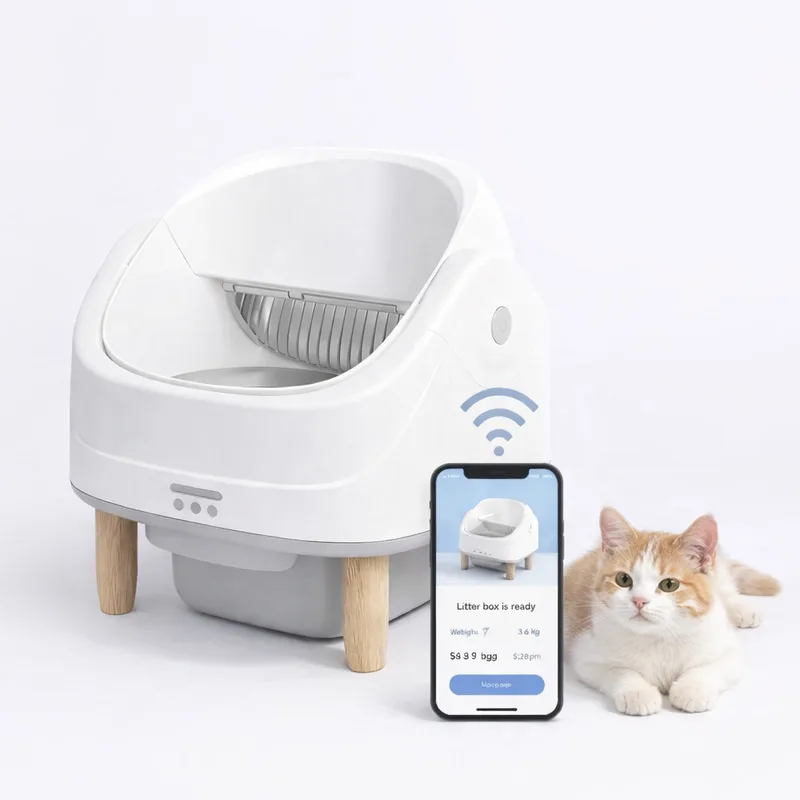
A self-cleaning litter box is an automatic unit raking or rotating litter into a sealed waste bin after each use. Audit safety architecture and interior volume before cosmetics. Our range brackets a 35L plastic-drum model and an open-top 70L interior unit at about 8kg, both APP-controlled with dual safety sensors that halt the cycle on entry. Standard catalogue items start at MOQ 50 pcs in 15-30 days; private label on existing tooling is MOQ 1,000 pcs; new-tool ODM is MOQ 3,000 pcs at 30-45 days including tooling. Compliance is CE/RoHS/FCC documented per model, with the pinch-point and sensor test file confirmed at order. In practice, sensor QC drives cost, so ask for the incoming-inspection AQL before you negotiate price. Our 2013-founded factory holds a defect rate below 0.5% across 1,000,000+ units annual capacity.
Key Specifications
The self-cleaning range brackets two sizes: a 35L plastic-drum model and an open-top 70L interior unit weighing about 8kg. Both are APP-controlled and use dual safety sensors that halt the cycle the moment an entry is detected. Odour control on the open-top model is an active-removal stage rather than a passive carbon pad, which matters for multi-cat households. Compliance covers CE, RoHS and FCC per model, with the pinch-point test and sensor logic confirmed at order. Because the drum size drives both the cat weight it suits and the return rate, buyers usually stock one mid-size unit and one large unit rather than a single compromise size.
How Litter Box MOQ and Lead-Time Tiers Work
At 50 pcs you buy a stock catalogue unit, so the drum and electronics are fixed. At 1,000 pcs OEM we keep the mould and apply your logo and packaging. At 3,000 pcs ODM we develop a new mould around your own design. Lead time tracks the tooling: 15-30 days for stock and private-label orders, 30-45 days for a new mould including tooling and sample approval. On a high-electronics product like this, the sample stage matters more than on a passive item, so budget time to run a real cat through the box before mass production rather than approving a sample on looks alone.
What to Verify Before You Place a Litter Box Order
Ask for the safety fail-safe in writing, the interior volume in litres and the incoming-inspection AQL. A self-cleaning box that does not stop when a cat is inside is the one failure a buyer cannot absorb, so request the pinch-point test file and the sensor logic rather than a verbal assurance. Confirm the drum size against the cat weight it is sold for, and check the adapter listing per market because it differs between the US and the EU. Sensor QC is the real cost driver here, so the AQL figure tells you more about long-run returns than the unit price does. {stats}
OEM versus ODM for Self-Cleaning Litter Boxes
OEM places your brand on our proven unit: logo and packaging on existing tooling, MOQ 1,000 pcs, 15-30 days, no mould investment. ODM builds a litter box that is yours alone: a new mould to your design, MOQ 3,000 pcs, 30-45 days including tooling. On a product with motors and sensors, the OEM route also lets you inherit a proven safety design, which shortens the regulatory review; the ODM route buys differentiation but carries more engineering time. Most buyers enter on OEM to learn the category, then move to ODM once the market and the returns data are known.
Frequently Asked Questions
What safety features should a self-cleaning litter box have?
A self-cleaning box must detect a cat inside the drum and stop before it rakes or rotates. The models we build use dual safety sensors and halt the cycle the moment an entry is detected; if a supplier cannot describe that fail-safe sequence clearly, treat it as a red flag. Ask for the pinch-point test file and the sensor logic in writing, not a verbal assurance. Compliance documentation for the unit should be filed per model - CE, RoHS and FCC - and confirmed against your target market at order, because the adapter listing and safety file differ by country. Safety is the one place in this category where a lower unit price is never worth the risk.
Why do self-cleaning litter boxes cost so much more than manual boxes?
The premium buys the motor, the sensor set, the sealed waste handling and the electronics, not just a larger plastic shell. A manual box is passive; a self-cleaning unit runs a geared motor, dual sensors, an odour stage and a control board, and the sensor QC is what keeps returns low. In practice the sensor set and the incoming-inspection AQL are the real cost drivers, so request the AQL figure before you negotiate unit price. Our two sizes - a 35L drum and an open-top 70L interior - cover single-cat and multi-cat buyers respectively, and both ship from MOQ 50 pcs for catalogue orders in 15-30 days.
Do you offer samples before a bulk order?
Yes. Sample orders are welcome on any catalogue model, and the sample cost is deductible from your first bulk order. For a stock or private-label item we can usually ship a sample within days because the tooling already exists; for ODM it has to follow the new tooling, so budget the sample inside the 30-45 day window. Send the target market and application detail with the request, because performance can shift with how the product is used. Treat the sample as a real test rather than a formality: run it, check the numbers that matter for your channel, and give us the findings, since that is far cheaper than discovering a fault across a 1,000-unit production run.
What warranty and after-sales support do you provide?
Products carry a 1-year warranty against manufacturing defects, backed by after-sales technical support and replacement parts. The warranty covers the motor, the control board and the moving mechanism, not normal wear or damage from misuse. Because we are the manufacturer rather than a trading company, support is handled directly with our engineering team, so a fault is diagnosed against the actual production batch instead of being passed to a third party. Keep your batch and order reference on file; it lets us trace the exact components used in your run and resolve a claim quickly, and it also helps us fold the fix into the next production cycle.