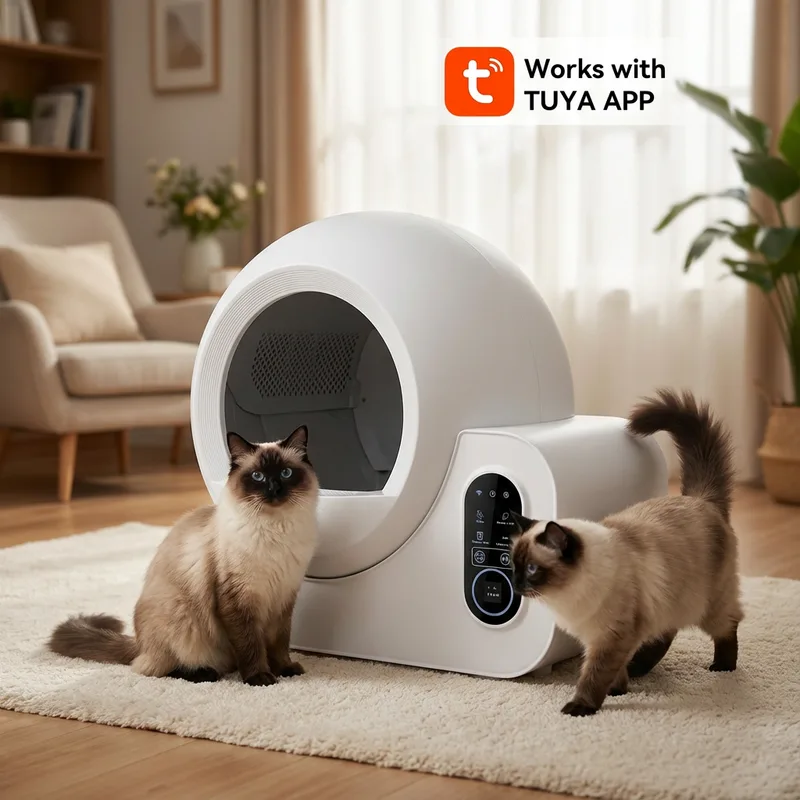
A cat litter box vs litter robot comparison is, for an importer, a sourcing decision: Litter-Robot sets the premium benchmark, PetKit wins on app ecosystem and design, and OEM smart boxes give you control over branding and margin. This spec-by-spec comparison shows where each option earns its place on a B2B shelf.
The choice usually stalls on the question that decides margin: brand stock or private-label OEM. This article works through it the way an importer needs to — spec by spec, from drawer capacity to spare-parts supply.
Why Compare Cat Litter Box vs Litter Robot Products at Spec Level?
On a listing page, every smart litter box looks similar: an enclosed globe, an app icon, a carbon filter. At container volume, the hidden differences decide whether you earn margin or handle complaints. A spec-level comparison answers what the customer actually gets, what you must support after the sale, and how much room is left for your own brand.
Head-to-Head: Litter-Robot vs PetKit vs a Typical OEM Smart Box
Brand prices below are as of 2026 public retail pricing; OEM terms are quote-based and move with volume, spec and customization tier.
| Spec dimension | Litter-Robot 4 (Whisker) | PetKit Pura series | Typical OEM smart box |
|---|---|---|---|
| Public price (2026) | ~USD 650–750 | ~USD 300–700 by model | Quote-based (FOB) |
| Rated cat weight | 3–25 lb (≈1.4–11 kg) | up to ~8 kg on current models | configurable; confirm per spec sheet |
| Drawer interval | ~1 week per single cat (manufacturer guidance) | comparable single-cat interval, sealed drawer | varies widely; ask how it is rated |
| Sensors | weight-based, multi-zone safety detection | infrared entry detection + weight | commonly infrared + load cell |
| App | Whisker app (iOS/Android) | PetKit app with multi-device ecosystem | white-label or platform app |
| Private label | none | none | logo, packaging, color, tooling, firmware |
Two things stand out. The brands compete on documented engineering and app polish; the OEM path competes on factory-direct pricing and control. The gap between brand retail and factory supply is exactly where importers build margin — or inherit after-sales costs.
Sump Capacity and Waste Drawers: How Long Between Empties?
Drawer capacity is the number customers will judge the product by, so define it before ordering. Whisker's published guidance for the Litter-Robot 4 points to roughly a week between drawer changes for a single cat, and PetKit advertises a comparable single-cat interval on its sealed-drawer models. OEM factories quote similar figures, but the definition matters: ask how many cats, which litter type and which drawer size the rating assumes.
Check what the drawer consumes, too. Whisker sells proprietary liner rolls, PetKit relies on drawer bags, and OEM designs split between standard bag rails and custom liners. Standard bags simplify your inventory but give up a consumable margin; proprietary liners do the reverse.
Entry Size and Weight Limits: Which Cats Actually Fit?
Whisker publicly rates the Litter-Robot 4 for cats from 3 to 25 lb (about 1.4–11 kg), which covers most adult cats in Western markets. PetKit lists its current models for cats up to roughly 8 kg, with entry geometry aimed at small-to-medium cats. OEM boxes vary more than either brand because entry size, globe diameter and load-cell range are all configurable.
Three lines deserve hard numbers from the factory: the minimum weight the sensors reliably detect, the maximum rated weight, and the unit's behavior when a cat is inside and a cycle is requested. A documented safety stop is a feature; silence is a liability claim.
Sensors and Safety: What Is Actually Inside the Shell?
The brands document their detection approach: Litter-Robot combines weight sensing with multi-zone safety detection, while PetKit pairs infrared entry detection with weight sensing. OEM quality spreads from careful multi-sensor designs to a single inexpensive infrared beam, and product photos will not tell you which you are buying.
Demand the spec sheet, not the catalog: sensor type and count, anti-pinch design, behavior on power failure mid-cycle, and the full-drawer response. A factory that cannot describe its failure modes in writing has answered your question. It is how we expect to be judged as well: our QC team signs off on sensor calibration and safety-stop behavior per batch, and we hold ourselves to the same spec sheet we hand buyers.
App Ecosystem: Who Owns the Customer Relationship?
The app decides whether this is a one-time sale or a platform. The Whisker app covers one brand's hardware; PetKit's app spans feeders, fountains and doors, which keeps customers inside one ecosystem. Both are maintained by teams whose consumer software reputation is on the line — the part an OEM buyer must replace with contract terms.
For an OEM box, ask who develops and hosts the app, how long updates are committed, which languages ship at launch, and how privacy requests under GDPR or CCPA are handled. A white-label app with no update commitment is a support queue in the making.
Private Label Space: What Can You Actually Customize?
Neither Litter-Robot nor PetKit offers private label, so customization is the OEM path's defining advantage. Treat it as four tiers:
- Tier 1: logo and retail packaging on an existing model — fastest and cheapest.
- Tier 2: shell color or finish changes on an existing mold.
- Tier 3: structural changes — entry size, capacity, drawer design — requiring new tooling, longer lead times and larger volume commitments.
- Tier 4: branded firmware and app, which ties back to the continuity questions above.
Most importers start at Tier 1 or 2 and move deeper once a model proves demand.
Spare Parts and After-Sales: The Supply Chain Behind the Warranty
A smart litter box is an appliance: motors, control boards, sensors and liners all have failure rates, and the unit lives with a live animal. With brand stock, after-sales runs on the brand's warranty process — verify what service actually exists in your region before ordering. With OEM, after-sales is what you negotiate: a written spare-parts availability window, a failure-kit ratio per container (spare motors, boards, sensors), and repair documentation your technician can follow.
The liner question returns here as well: standard bags offload consumable logistics onto the customer; proprietary liners keep recurring revenue — and the stock burden — with you.
Brand Goods vs OEM: How Should You Structure the Shelf?
The comparison resolves into a shelf-structure decision rather than a single winner:
- Premium anchor: Litter-Robot stock signals you carry the category's reference product — lowest margin per unit, strongest brand pull.
- Design-led mid-premium: PetKit suits design-conscious retail and customers already inside its ecosystem.
- Margin engine: OEM private label covers the mid-market band, customized to your market, with margin that funds the brand stock above it.
Many healthy ranges do all three. If you are still mapping the alternatives landscape before committing capital, our Litter-Robot alternatives sourcing guide walks through that broader evaluation; this article handles the layer beneath it — which spec sheet deserves your deposit.
FAQ
How much does a Litter-Robot cost compared with a PetKit litter box? As of 2026 public pricing, Litter-Robot models typically list around USD 650–750, while PetKit's Pura series spans roughly USD 300–700 depending on model and promotions. OEM units are quote-based and usually land well below brand retail at comparable volumes.
Are OEM smart litter boxes as safe as brand models? They can be, but safety is a per-factory answer. Compare sensor count and type, anti-pinch design, power-failure behavior and destination-market certifications (CE, UKCA, FCC, RoHS) line by line. Brands publish more documentation; a factory that matches it in writing is a different proposition from one that matches it in photos.
What MOQ should I expect for a private-label smart litter box? It varies by factory and customization tier. Logo-and-packaging private-label runs typically start from a few hundred units in our production planning, while new tooling needs larger commitments to amortize. Ask each factory to state MOQ and mass-production lead time in the proforma invoice.
Do OEM boxes use the same app as PetKit or Whisker? No. Expect a factory-owned white-label app or a third-party platform app. The contract items that matter are update commitments, language coverage and who controls the account your customers join.
Which single spec should an importer scrutinize hardest? The weight-detection window — the minimum that triggers a reliable safety stop and the maximum rated cat weight. It is where customer safety, returns and warranty exposure all intersect.
The Importer's Spec Checklist
Put every candidate factory against the same list before comparing quotes:
- Drawer: rated interval, assumed cat count, litter type, consumable type.
- Weight window: minimum detection, maximum rating, cycle-interrupt behavior.
- Sensors: type, count, redundancy, power-failure behavior.
- App: owner, update commitment, launch languages, privacy compliance.
- Customization tier: logo, color, tooling, firmware — priced line by line.
- After-sales: spare-parts window, per-container failure kit, service documentation.
- Certifications: destination-market requirements confirmed in writing, never assumed.
Run two or more factories through this list and the differences will price themselves. To start, send PetTech Global your target specs and volumes — as a manufacturer, we will quote your private-label smart litter box factory-direct, with MOQ and tooling lead times based on what our production lines can actually schedule.


