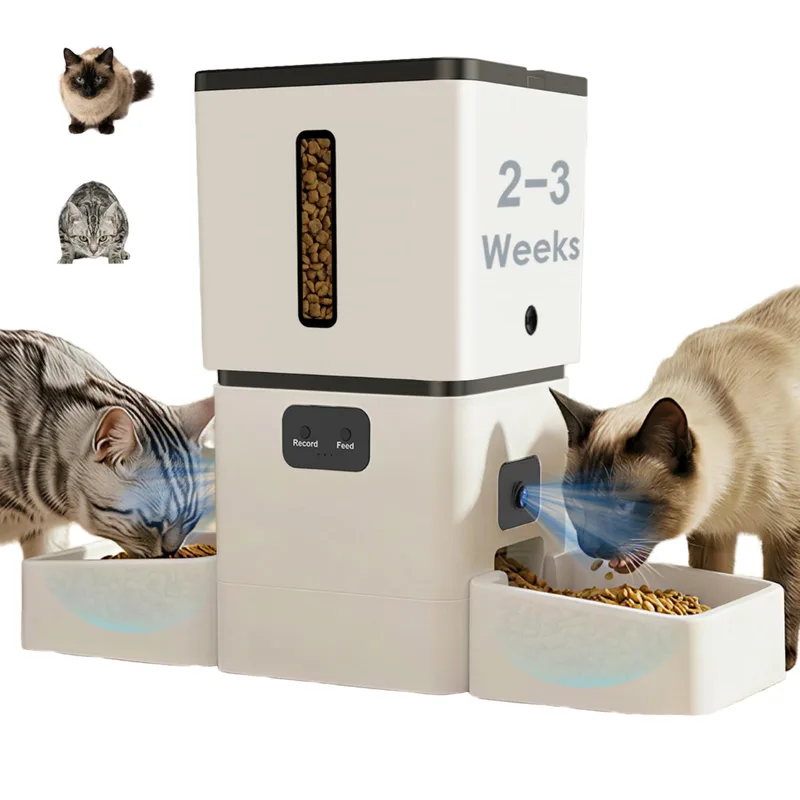
An automatic pet feeder is a timed dry-food dispenser releasing set portions from a sealed hopper. For wholesale buyers, three numbers decide feasibility before price: hopper capacity, portion increment and MOQ. Our feeder line runs 2L to 8L tanks; the 8L model adds a WiFi camera and voice-recording module on a rechargeable pack, while the 4L runs 110-240V with CE/RoHS/FCC documents filed per model. Standard catalogue feeders ship from MOQ 50 pcs in 15-30 days; private label on our existing tooling is MOQ 1,000 pcs; new-tool ODM is MOQ 3,000 pcs with a 30-45 day lead, tooling included. Annual capacity is 1,000,000+ units across an 18,000 m2 plant, so a 1,000-unit run is routine. For example, the 8L camera feeder lists at $14.69-$22.99 ex-works.
Key Specifications
The feeder range spans 2L, 4L, 6L and 8L food tanks. The 8L flagship carries an integrated WiFi camera and a voice-recording module on a rechargeable pack; the 6L WiFi model adds HD camera and double bowls; the 4L runs on 110-240V with CE, RoHS and FCC documents filed per model. Portioning is a scheduled dry-food mechanism rather than a scale, so the figures that matter are the gram increment and the hopper-to-bowl drop consistency. Filing, colour and packaging can all be customised on the existing moulds, so a wholesale buyer can vary branding per market without paying for new tooling.
How Feeder MOQ and Lead-Time Tiers Work
The three MOQ tiers map to how much of the product we actually change. At 50 pcs you are buying a stock catalogue feeder, so the mould, colour and packaging are already set and the only work is picking and packing. At 1,000 pcs OEM we keep the same mould but apply your logo, silk-screen and retail packaging. At 3,000 pcs ODM we cut a new mould around your design and run samples for approval. Lead time follows the same logic: stock and private-label orders need 15-30 days because the tooling exists, while a new mould adds tooling itself and pushes the order to 30-45 days. The tier you pick is really a decision about how much of the product is yours versus ours.
What to Verify Before You Place a Feeder Order
Ask for the portion increment in grams, the hopper-to-bowl drop consistency and the motor duty cycle before you discuss price. A feeder that dispenses uneven portions or jams on kibble dust generates returns, and the fix at the factory is a better auger rather than a lower price. Request a pre-production sample on the exact kibble size your market uses, and check the power path, because the 4L runs 110-240V while the 8L camera model uses a rechargeable pack, and the adapter listing differs between the US and the EU. Compliance should be CE, RoHS and FCC filed against the specific model, never a blanket claim. Our factory was established in 2013, runs an 18,000 m2 plant with 750+ staff and 60+ R&D engineers, and ships to 80+ countries on an annual capacity of 1,000,000+ units.
OEM versus ODM for Pet Feeders
OEM suits a buyer who wants their own brand on a proven design quickly: your logo and packaging on our existing tooling, MOQ 1,000 pcs, 15-30 days, no mould investment. ODM suits a buyer who wants a product nobody else has: a new mould cut to your design, MOQ 3,000 pcs, 30-45 days including tooling, and full ownership of the shape. The trade-off is speed and cash against differentiation. Most first-time buyers start with OEM on one or two models to test the market, then move the winners to ODM once demand is proven. Both routes run from the same plant, so the quality process does not change between them.
Frequently Asked Questions
What is the MOQ for automatic pet feeders?
Standard catalogue feeders ship from 50 pcs per model. If you need your logo, silk-screen and packaging applied to our existing design - private label, OEM - the MOQ is 1,000 pcs per SKU, because we are running an existing mould and only changing the branding and pack. If your design requires a new mould, that is ODM and the MOQ is 3,000 pcs, with tooling and samples included inside a 30-45 day lead time. Buyers sometimes ask to split one order across two models; we can, but each model carries its own MOQ, so plan the split around that rather than treating 1,000 as a blanket total.
How long does production take after deposit?
Catalogue and private-label orders on existing tooling ship within 15-30 days of deposit confirmation, because the mould already exists and the line only needs scheduling. New-tool ODM orders take 30-45 days including tooling, sample approval and mass production. Our monthly throughput sits inside an annual capacity of 1,000,000+ units across an 18,000 m2 plant with 750+ staff, so a 1,000- to 3,000-unit run is a normal scheduling slot rather than a favour. If you have a fixed retail launch date, share it early - we can often hold a production slot for a deposit, but we cannot compress tooling time.
Do you offer samples before a bulk order?
Yes. Sample orders are welcome on any catalogue model, and the sample cost is deductible from your first bulk order. For a stock or private-label item we can usually ship a sample within days because the tooling already exists; for ODM it has to follow the new tooling, so budget the sample inside the 30-45 day window. Send the target market and application detail with the request, because performance can shift with how the product is used. Treat the sample as a real test rather than a formality: run it, check the numbers that matter for your channel, and give us the findings, since that is far cheaper than discovering a fault across a 1,000-unit production run.
What warranty and after-sales support do you provide?
Products carry a 1-year warranty against manufacturing defects, backed by after-sales technical support and replacement parts. The warranty covers the motor, the control board and the moving mechanism, not normal wear or damage from misuse. Because we are the manufacturer rather than a trading company, support is handled directly with our engineering team, so a fault is diagnosed against the actual production batch instead of being passed to a third party. Keep your batch and order reference on file; it lets us trace the exact components used in your run and resolve a claim quickly, and it also helps us fold the fix into the next production cycle.