Self-cleaning litter boxes cost three to five times more than a manual box, and the people who sell them rarely explain what that premium actually buys. This comparison breaks the decision into six measurable dimensions so buyers can judge it on numbers rather than marketing claims.
1. Purchase Cost and Cost Per Year
The purchase price is the most visible difference and the least important one. What matters is the total cost of ownership across a normal three-year service life.
| Cost item | Manual box | Self-cleaning box |
|---|---|---|
| Purchase price | Low, entry category | 3–5x manual |
| Litter consumption | Higher — full tray changes | Lower — sifting preserves clean litter |
| Consumables | Litter bags, scoops | Waste liners, carbon filters |
| Repair exposure | Near zero (no moving parts) | Motor, sensors, gears over time |
The cost gap narrows over time because self-cleaning units waste less litter: sifting removes clumps while leaving clean litter in the drum, which is a genuine running-cost reduction.
2. Cleaning Time
Manual boxes require scooping at least once daily and a full litter change roughly weekly. That works out to several hours per month per box.
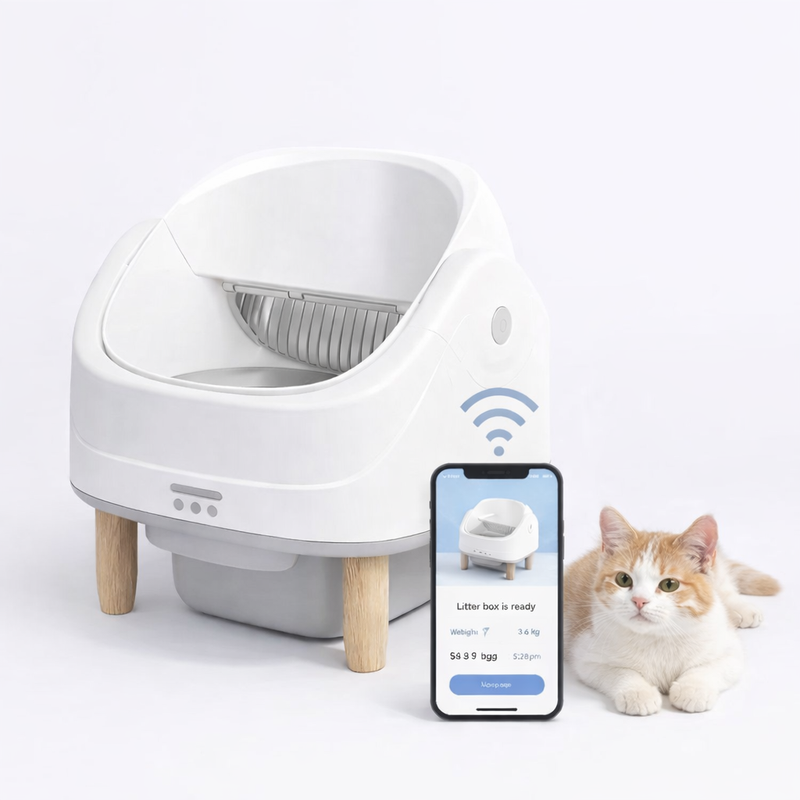
Self-cleaning boxes reduce the routine to emptying a sealed waste drawer — typically once every several days to a week depending on cat count — and a periodic deep clean of the drum.
For multi-cat households the difference compounds. Three cats on manual boxes means scooping multiple times a day; on a self-cleaning unit it means emptying one drawer more often.
3. Odor Control
This is the dimension where self-cleaning units have a structural advantage, and it is not about the automatic cycle — it is about the sealed waste compartment. Clumps leave the litter area immediately and sit in an enclosed drawer with a carbon layer, instead of remaining exposed in the tray.
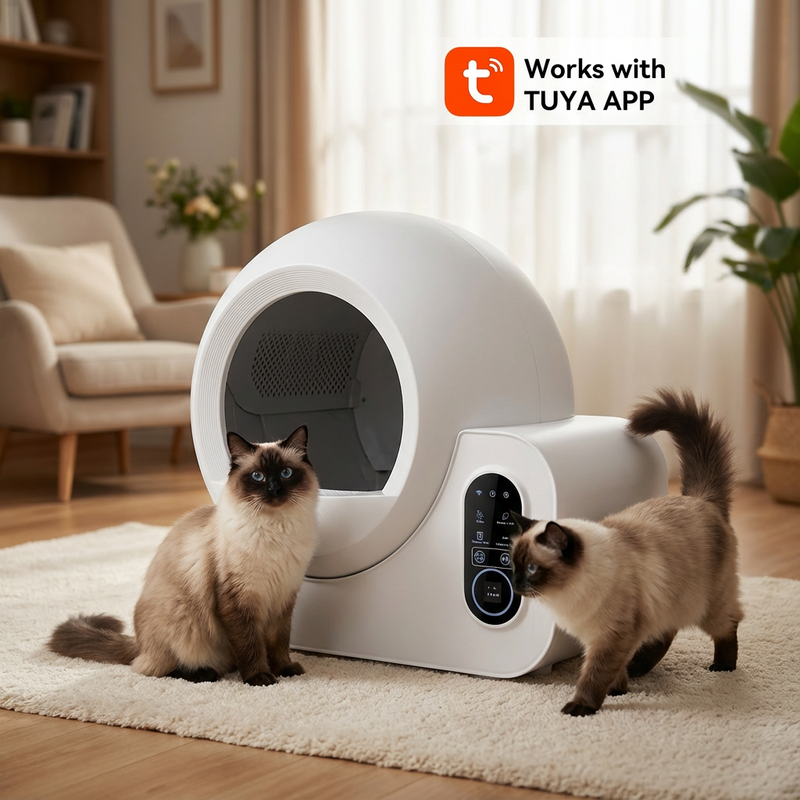
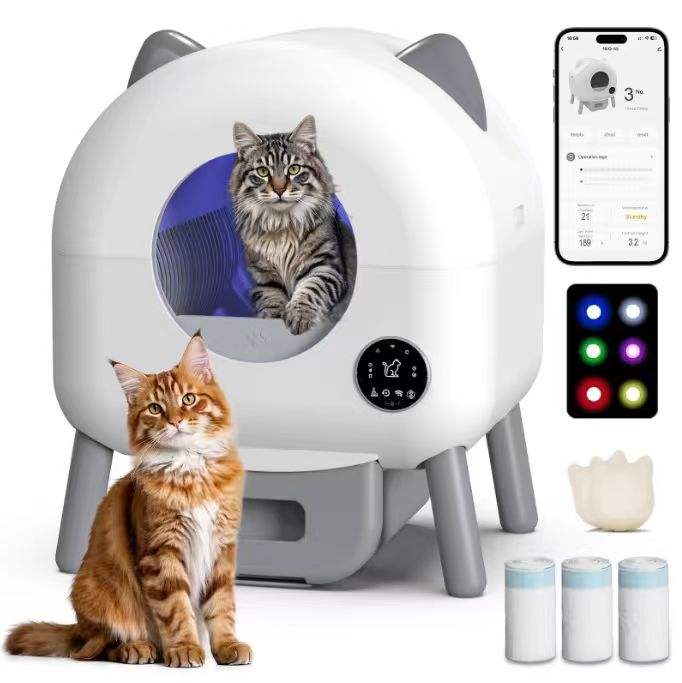
Our 70L app-controlled self-cleaning model pairs a sealed drum with an eco deodorizing stage, which is what allows a box to sit in a living area without announcing itself. Manual boxes cannot match this without daily scooping discipline, which most owners do not sustain.
4. Cat Acceptance
The most common reason a self-cleaning box gets returned is not a mechanical fault — it is a cat that refuses to use it. Cats are conservative about elimination spaces.
- Entry height and step: top-entry and high-walled units exclude senior cats and small kittens.
- Interior space: the usable litter area matters more than the exterior footprint.
- Noise: a loud cycle after a nervous cat leaves will discourage repeat use.
- Transition: leaving the old box available during the first two weeks dramatically improves acceptance.
Our open-top dual-safety sensor model was designed around this constraint: low entry, generous interior, and a quiet cycle.
5. Failure Modes and What They Cost
| Failure mode | Manual box | Self-cleaning box |
|---|---|---|
| Sensor misfire during use | Not applicable | Safety-critical; blocked by dual-sensor designs |
| Motor or gear wear | Not applicable | Rated cycle life is the key spec |
| Litter type mismatch | Forgiving | Clumping litter required |
| Waste drawer seal | Not applicable | Gasket and carbon layer degrade |
The conclusion is straightforward: a manual box has essentially no failure surface, while a self-cleaning box concentrates all its risk in the sensor and drive assembly. That is exactly where buyers should direct their due diligence.
6. Sizing and Capacity
Undersized boxes drive returns in both categories. A 35L drum is the practical floor for households with more than one cat; below that, the drawer fills faster than owners expect and the unit smells.
See the 35L plastic drum model and the larger 70L app-controlled model for two points on the capacity spectrum.
7. OEM and Private Label Considerations
For retailers selling under their own brand, the manual category leaves little room for differentiation — the product is the same box with a different label. Self-cleaning units support custom colourways, packaging and app branding, which is what protects margin against marketplace price competition.
Our OEM self-cleaning model is configured for private label buyers, and the new app-controlled model with odor removal covers the premium tier.
Conclusion
Manual boxes remain the right choice for budget-sensitive buyers, senior cats, and anyone who will not tolerate an electronic failure. Self-cleaning boxes justify their premium for multi-cat households, owners who travel, and buyers who value odor containment above all. The decision is not about which is better — it is about which failure mode the buyer can live with.
Written by the PetTech Global Product Team. We manufacture self-cleaning litter boxes, feeders, fountains, grooming tools and interactive toys for distributors in more than 80 markets. Contact us for specifications, samples or a wholesale quotation.