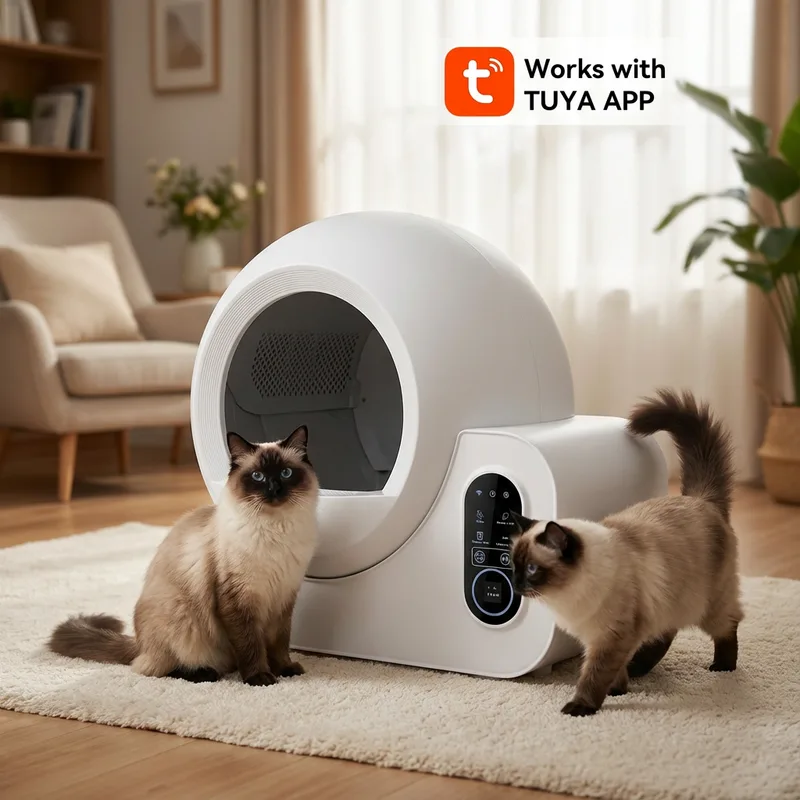
Choosing an app ecosystem is choosing who is allowed to lock you out of your own product. On a platform stack the lock arrives as someone else's policy change; on a proprietary stack you build the keys yourself and pay for them monthly — and either way, the terms you fail to settle before tooling are the terms you will live with.
What a platform stack hands you on day one
The platform route designs the product around a Tuya module and the Tuya cloud behind it. The app is already written; you contribute a logo, a color scheme and the product name. Voice integration with Alexa and Google comes as part of the package, and platform data centers serve multiple regions. Two of our feeders ship on that stack today: a 4L automatic pet food dispenser controlled through the Tuya app, and a 4L/6L OEM dual-bowl camera feeder.
What you are really buying is time. The connectivity engineering, the app-store listing and the baseline cloud infrastructure are finished before you arrive, freeing attention for hardware, packaging and channel. For a marketplace seller trialing its first connected product, or a chain building a private-label line, that head start is often worth more than any differentiation a custom app could deliver later. Program volume math sits in our automatic pet feeder wholesale guide.
What the platform dependency charges you later
The price of that convenience is control. The platform holds the cloud, draws the feature roadmap and governs the accounts. When a policy shifts, a fee climbs or an outage outlasts expectations, the complaints land on the buyer — who does not own the system. A contract can shift some of that risk around; it cannot make the platform vanish.
There is also a differentiation ceiling: once every brand in a category ships the same app behind a different logo, the app no longer decides which product a shopper picks. Our cloud outage reliability guide for smart feeders records what an outage costs in practice.
Running a proprietary app means running a software company
A proprietary app is not a one-time development fee. It is an iOS and Android product in permanent beta, a cloud service, a patch cycle and a user-facing desk. Count six to twelve months of build time before the first unit ships, with running costs from launch day onward. OS updates follow someone else's calendar, app-store review can delay a fix, and a field firmware bug becomes release management rather than factory rework.
The legal exposure tracks the software. Where a product gathers personal data from customers in the EU, the obligations for how that data is used tend to sit with the importer rather than the factory. That means a privacy notice, a lawful basis, a retention policy and a deletion process — each with a named owner. Ask in writing who maintains the app after launch, who answers a data request and who ships patches when a phone update breaks pairing. If the answer is the factory, attach a service level to it. Our GPSR compliance checklist for smart pet electronics and importer compliance countdown map the paperwork.
The comparison buyers should run before committing
Side by side, the choice becomes procurement math rather than philosophy.
| Dimension | Tuya-based stack | Proprietary app |
|---|---|---|
| Certification responsibility | CE, RoHS and FCC verified per finished model on our QC line — whichever stack you choose. | Same per-model hardware check, plus the importer's software documents: privacy notice, lawful basis, retention policy, deletion process. |
| App brand ownership | Your logo on a licensed stock app; license term, renewal price and expiry consequences belong in a clause. | The app is yours outright, with iOS and Android releases, patches and the support desk. |
| Cloud dependency | Platform runs the cloud, roadmap and account governance; outages and policy changes follow its schedule. | You run the cloud, set the uptime target and answer for incidents; running cost starts day one. |
| Data ownership | Customer and device data sit on platform servers unless the contract grants a machine-readable export. | Data sits in a cloud you own, along with EU access and deletion duties. |
| Long-term cost | Low entry cost, faster first shipment, with fee and policy risk you do not control. | Six to twelve months of build before the first unit ships, then multi-year maintenance. |
Five contract clauses to settle before the mold is cut
Whichever path you choose, the contract should answer the same questions — five clauses are the minimum for a connected product.
- Firmware ownership. Draw a line between the platform's stock firmware and your program's custom code; state who owns that code and who inherits bug fixes, security patches and derivatives.
- App brand license. When your logo sits on a stock app, pin down the license term, the renewal price and the expiry consequences — a lapsed license can take the interface with it.
- Data ownership and export. Specify the data that belongs to you, the machine-readable export format and the pull frequency. Skip this and your customer list lives on a server you do not control.
- Migration and exit. Spell out a tested route to a second cloud or a replacement app, the handover window and the support the supplier commits to. A general promise to help is not a clause.
- Supply continuity. Cover spare parts, firmware updates and security fixes through the warranty period and a defined stretch beyond; if SKU support ever stops, the installed base needs a plan.
Whenever the product leans on someone else's cloud, attach a service-level schedule covering uptime and incident notification — brief wording, but every number measurable. We ask buyers to put these five points on the table before we start cutting a mold.
Which route fits which stage of the business
A marketplace seller with a fresh listing needs speed and a credible app first — a branded-skin Tuya build is usually the lower-risk way in. A chain attaching a private label needs the same speed wrapped in contract protection; the five clauses count for more than the app's visual identity. A brand whose promise is the software itself should take proprietary control, budgeting build and maintenance as a multi-year commitment, not a factory option.
Production mechanics do not move with the app choice. On our lines, OEM programs begin at 1,000 units quoted at 15 to 25 days of production, ODM at 3,000 units across 30 to 45 days, and a private-label trial can start at 50. The app choice sits upstream of those timelines: a Tuya SKU borrows an existing module; a proprietary build adds its own software schedule. The wider sourcing frame is in our sourcing checklist for OEM pet products.
Plan the exit before the deposit
Buyers often assume a start on Tuya can later step over to their own app. The move depends on three things: a data export right, firmware that can be re-aimed at a second cloud, plus a migration window the supplier will stand behind. Without the export, migration means asking every customer to re-register. Skip the firmware path and the move becomes hardware replacement. Both are expensive ways to learn that the contract should have said more. If migration is the plan, hold the app name and account flow steady, shift users in cohorts, and trial the replacement cloud with a small group first — the customer should notice a better app, not a change of ownership.
Contract questions buyers put to us before signing
Who owns the firmware?
Stock platform firmware normally remains the platform's property, licensed with the module. Custom code written for your program should sit under an assignment or license clause reaching derivatives — bug fixes, security patches and feature updates. If the contract is silent, whoever holds the code decides later.
Can I move users to my own app later?
Only if the contract hands you both the data and the technical path: a machine-readable export covering user and device data, firmware that can be re-aimed at a second cloud, plus a migration window the supplier stands behind. Without those, moving users means re-onboarding them one at a time.
Does the app choice change the production timeline?
Not the factory schedule: OEM runs begin at 1,000 units in 15 to 25 days and ODM at 3,000 in 30 to 45, regardless of software. What moves is the pre-production phase — a Tuya SKU borrows an existing module, while a proprietary build inserts six to twelve months of software work before the first saleable unit.
Start from the kind of buyer you actually are, not the app you admire. The cheapest contract answers the exit question before the first deposit; the most expensive discovers it after the mold is cut. Once the stack choice is settled, request a quote and we will confirm module options and sample terms.