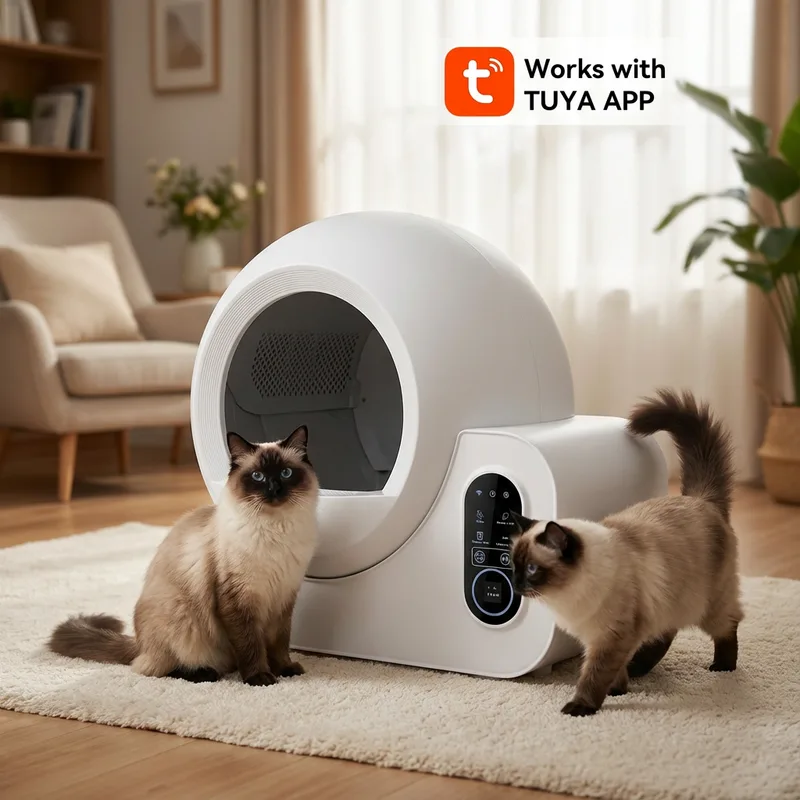
Two litter boxes that look identical in a listing photo can sit a full quality tier apart at the drive, and the cheaper build usually announces itself months later as a jam-and-retry failure. Our assembly bench sets those tiers with a grade sheet rather than marketing language, and the version below is the one we issue with every sample — the same logic behind our motor quality tier guide.
| Build input | Tier A drive | Tier B drive | Tier C drive |
|---|---|---|---|
| Copper winding | Full-slot copper fill | Lighter winding fill | Baseline export build, cost-led |
| Bearings | Sealed ball bearings at both shaft ends | Bronze bushings | Bushing class or lower |
| Braking | Ramped electronic brake, soft-dock into home position | Abrupt brake, chosen to save development time | Braking logic may be skipped; a foam bumper takes the impact |
| Bench signature | Quiet settle at the end stop | A knock against a hard stop | A gritty note can surface within a few hundred cycles |
| Where it fits | Flagship retail; standard drive in the 70L open-top dual-sensor model | Light-duty or promotional builds | Listings priced where no warranty past six months survives |
The grading sheet — winding weight, bearing class, firmware version — travels with every sample on request, 70L units included.
Why the drive defines the whole product
Inside every sifting litter box sits a geared DC drive whose single job is turning the drum after each cat visit. Undersize it and the failure chain reads like a script: a clumped load stalls the sift, the controller sees a jam and tries again, the retries cook the windings, and the thermal fuse opens for good. So our engineers give the 70L app-controlled model's drive headroom for the worst clump it will ever lift, not merely the typical one. Printed ratings and measured windings do not always agree, which is exactly why the sample outranks the spec sheet. The same logic separates self-cleaning units from manual boxes: the mechanism earns its keep every single day.
Copper mass and bearings, where tiers quietly diverge
In a drive motor, copper is the biggest single cost — and the thing it purchases is lifespan. More copper in the slots lowers resistance; lower resistance strips heat out of every cycle; and a winding that runs cool keeps its varnish insulation intact, which matters because that varnish is the component that ages first. Gearbox grease benefits too, since a cool housing stops it thinning and wandering. Bearings usually fail more quietly — a bushing's bore ovalizes under load, play creeps onto the shaft, play becomes rattle, and the rattle ends as a noise complaint, then a refund request. A sound drive hums through its cycles; builds running worn bushings pick up a gritty note somewhere inside the first few hundred. No one on our assembly line has watched cheap bearings improve a repeat-order rate.
Braking firmware, the line most quotations skip
A drum's stopping behavior shapes its lifespan as much as its torque, because every hard stop knocks the gear train and packs litter dust into the bearing seals. In Tier A firmware the drum meets a ramped electronic brake and glides to its home position; Tier B stops hard because that saves development time; Tier C sometimes carries no braking logic at all, letting a foam bumper absorb the hit until it flattens inside a year. Our app-controlled smart cat toilet pairs ramped braking with a jam-retry cap of two attempts, and firmware carries a per-SKU version at our factory, so the code in your sample can be matched to its build sheet.
Fifteen bench minutes that settle the tier question
Arrival samples can be graded without laboratory equipment. Put the drive assembly on a shipping scale first: winding copper is heavy, so the higher tier shows up as extra grams. Then load the drum fully and run twenty back-to-back sift cycles; a sound build leaves the housing warm rather than hot. Listen at the end stop, where a soft-dock finish arrives quietly and a hard-stop build gives an audible knock. Close with the label: confirm that the CE, FCC and RoHS marks name the exact model ordered, since certificate scope wanders across variants — the GPSR countdown for smart litter box importers explains what EU checks now expect. The whole routine takes about fifteen minutes and mirrors what a factory sample can and cannot prove.
Order sizes, warranty terms, and reading consumer awards
Wholesale trials begin at 50 to 100 units. At 1,000 units our OEM service adds your logo, packaging and firmware splash across a 15-25 day run; ODM development with new molds asks for 3,000 units over 30-45 days and suits a different drum geometry or your own app skin. The 12-month warranty covers the whole range, and samples precede every program we run as an OEM supply partner; expectations for wholesale safety, volume and MOQ sit in our buying guide. Consumer tests deserve a careful read: Good Housekeeping has kept one box on its favorites list for four years, and the transferable lesson there is component survival, not the logo on the award. Ask which drive tier the tested unit carried, request the endurance protocol, and compare warranty verbs. A cat approving a box for four years makes a charming photo; a winding sheet with gram weights supports a purchase order.
Three questions buyers hand us across the bench
How do I confirm a motor tier before money moves?
Ask for the build sheet first, then let the sample prove it: weigh the drive, cycle it under a realistic litter load, and listen at the home position. Each sample leaves us with its sheet — winding weight, bearing class, firmware version — so your bench work double-checks the paperwork rather than substitutes for it.
What does the 12-month warranty actually cover?
It covers manufacturing defects in materials and workmanship across the whole range, drives included. A claim arrives with the SKU, the batch code and a short failure description; we settle confirmed claims with replacement units or credit on the following order, and every claim is written into the build record so a repeating pattern forces a fix at the source.
Do your other product lines follow the same grading?
The feeder line, priced from $14.69 to $69.99, grades drives by gear-train class; water-fountain pumps are graded by bearing and impeller material; grooming tools by battery cell grade and seal integrity. Different categories, one inspection habit — that is how our factory keeps quality auditable across a catalogue.
Sourcing tier-graded litter boxes? Request a quote through the inquiry form and ask for the motor grading sheet with your sample.