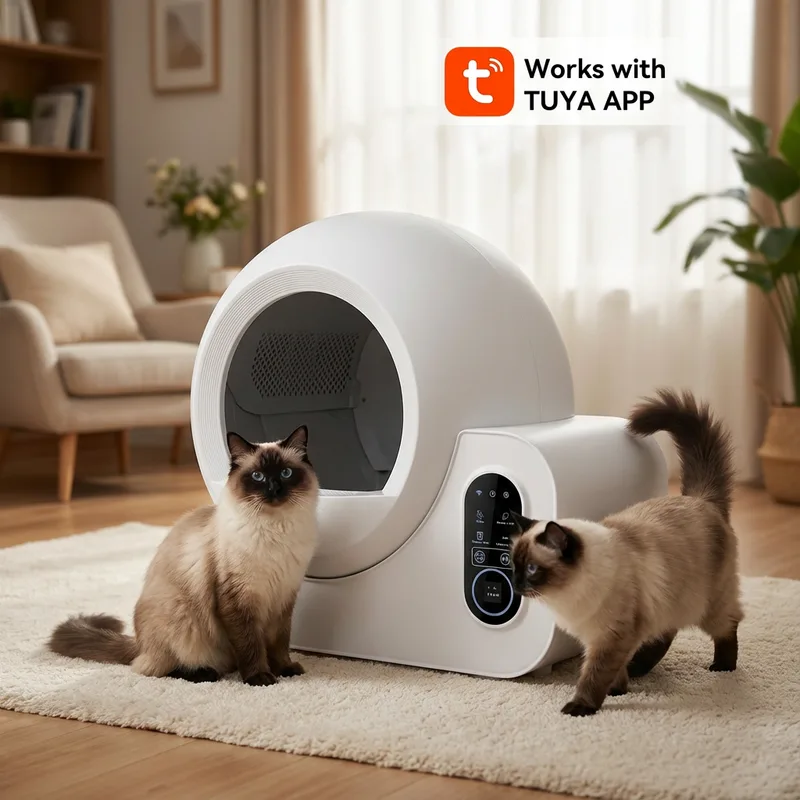
Most warranty claims on self-cleaning boxes trace back to a component that never appears in the product photos: the drum drive. If your quotation does not name a motor grade, you are buying whatever sat on the receiving rack that morning — and your customers will find out around month six.
| Grade | Incoming test on our line | Curve under a clumped load | Where this tier usually lands |
|---|---|---|---|
| A | Full torque-curve sweep against simulated clumped waste | Holds output flat until close to stall | Our 35L and 70L drum platforms, OEM programs |
| B | Rated-load spot check, single pass | Output sags past the half-rating mark | Mid-shelf house brands |
| C | On/off spin test, nothing further | Loses pull from the first kilogram onward | No-name export cartons, failures in the first months |
What the grade on your bill of materials actually controls
The gearmotor turns the drum on every cycle, and the words DC motor on a spec sheet describe none of what matters. Torque decides whether a clumped load completes the turn or stalls halfway. Gear quality decides whether that stall ends in a quiet halt or a cracked housing. Sensor feedback decides whether the firmware calls a stop before anything jams. Drop one of the three and the support inbox starts filling within a single quarter.
An open-top design raises the stakes, because the drum and the waste bed sit in full view. When a drum jams there, the buyer watches it happen, and a failure you can see becomes a refund demand within days. That is why our assembly line grades every incoming gearmotor before a single screw is driven — the table above is the incoming QC rule, not marketing copy.
Reading a torque curve without an engineering degree
Ask for one chart — output plotted against load — and it will expose the tier sooner than any datasheet can. A Grade A part holds its line until nearly stalled. Grade B gives ground once the load passes half its rating. Grade C loses pull from the first kilogram. Wattage predicts none of this reliably; a small motor with a flat line out-pulls a bigger unit whose curve droops, so request the curve rather than the watt figure.
Any factory can produce the chart in an afternoon. If a supplier cannot or will not send it, that silence is already your answer.
How a stall should end: cutoffs, alerts and recovery
Load any motor until rotation stops and the recovery story separates the grades. Grade A detects the spike, cuts the cycle and fires an alert to the app. Grade B claws back on light loads, though its firmware gains nothing from the episode. Grade C runs hot, trips no sensor at all and sits there until someone walks over. On a litter box this is not an abstract failure mode — a jammed drum beside a cat is the photo that ends up on social media, not a service ticket.
For exactly this reason, dual cutoffs ride alongside the drive on our 35L plastic-drum model. Test it on the sample you already have: stop the drum with your palm and time how quickly the unit shuts down. The correct answer is near-instant.
Gears and position sensors: where year-two noise begins
The gear train trades motor speed for torque, and its materials tell on the tier. Dust from sintered metal gears collects inside the housing until backlash sets in, while hardened steel tolerates years of sand-heavy clumping litter. Position reporting comes from a lone limit switch, or from paired Hall sensors that let firmware correct drift before the drum sits crooked. In year two, noise usually traces to gear wear rather than the windings, so the gear specification belongs on the written quote.
At the 1,000-piece OEM tier, the Grade A build adds a few dollars per unit. Measured against a warranty reserve, it is the cheapest insurance in this category.
Four hands-on checks that need no instruments
- At the halfway point of a turn, a Grade A build hums while a cheap one whines under load.
- Near the drive end, the housing should feel heavy — a proper gearmotor carries real mass.
- Cycle the unit with wet clumping litter loaded to twice the normal volume.
- Stall the drum deliberately with your hand, then verify that the cutoff engages and the app alert fires.
That sample becomes your golden reference — inspect incoming production against it piece by piece. A factory sample proves specific things and misses others, so run these checks before price talks begin: a certificate folder says less than the noise the drum makes at mid-turn.
Cost, MOQ and the paperwork that protects you
Grade choice shifts unit cost by only a few dollars, while the warranty reserve swings far wider. As a price band, wholesale on our feeder line spans $14.69 to $69.99; litter systems list higher thanks to drum hardware and sensors. Terms: 50 units opens the catalogue items; OEM begins at 1,000 units over a 15–25 day production window; ODM with new tooling asks 3,000 units and 30–45 days. The way tiered pricing moves unit cost applies here — grade the quotes first, compare on price only after.
Make the grade a contract line: write it into the BOM, then verify it again at production, because mid-run swaps are a documented behaviour. Combining categories? Ask our export desk for a mixed container — we quote the 6L app-controlled feeder on exactly that structure, and feeder MOQ and lead-time detail lives on the blog.
Motor grade questions our export desk hears weekly
Do open-top designs demand a heavier-duty drive?
Yes. An exposed drum works under the whole waste load, in plain sight, while wet clumps pile on unpredictable weight as the day goes on. Users watch the cycle, so one stall reads as a refund demand that same day, not a private annoyance. That is precisely why Grade A motors and dual safety sensors come standard on our 70L open-top platform quote; the wholesale basics for this category cover the platform options.
Can a repeat order move from Grade B up to Grade A?
Between runs, this is handled as a documented BOM change. Put the request in writing on the next PO, confirm the gearmotor supplier, update the BOM revision and re-test new-run samples against the torque curve before shipment. Private-label minimums stay at 1,000 units over the standard 15–25 day run. Start from a returns audit, and hold onto one unit of each tier as reference.
Which approvals deserve a check before signing?
For the EU market, CE; for the US, FCC; plus RoHS covering hazardous substances — verified per exact SKU rather than brand or family certificate, since family-level paperwork never carries over to a private-label unit. Any BOM or firmware change triggers a fresh check, and at receiving the certificate numbers should be matched against the carton labels. Our GPSR checklist for EU shelves extends this file set.
What physically separates a top-tier drum motor?
Copper fills the winding slots completely, sealed bearings sit at both shaft ends, and the lubricant is matched to the drum load. Each of those three is where lower tiers cut corners, invisibly — until month six arrives with the returns.
Planning a litter program? Start an OEM enquiry and ask that the torque curve and grade documentation travel with the first reply.